
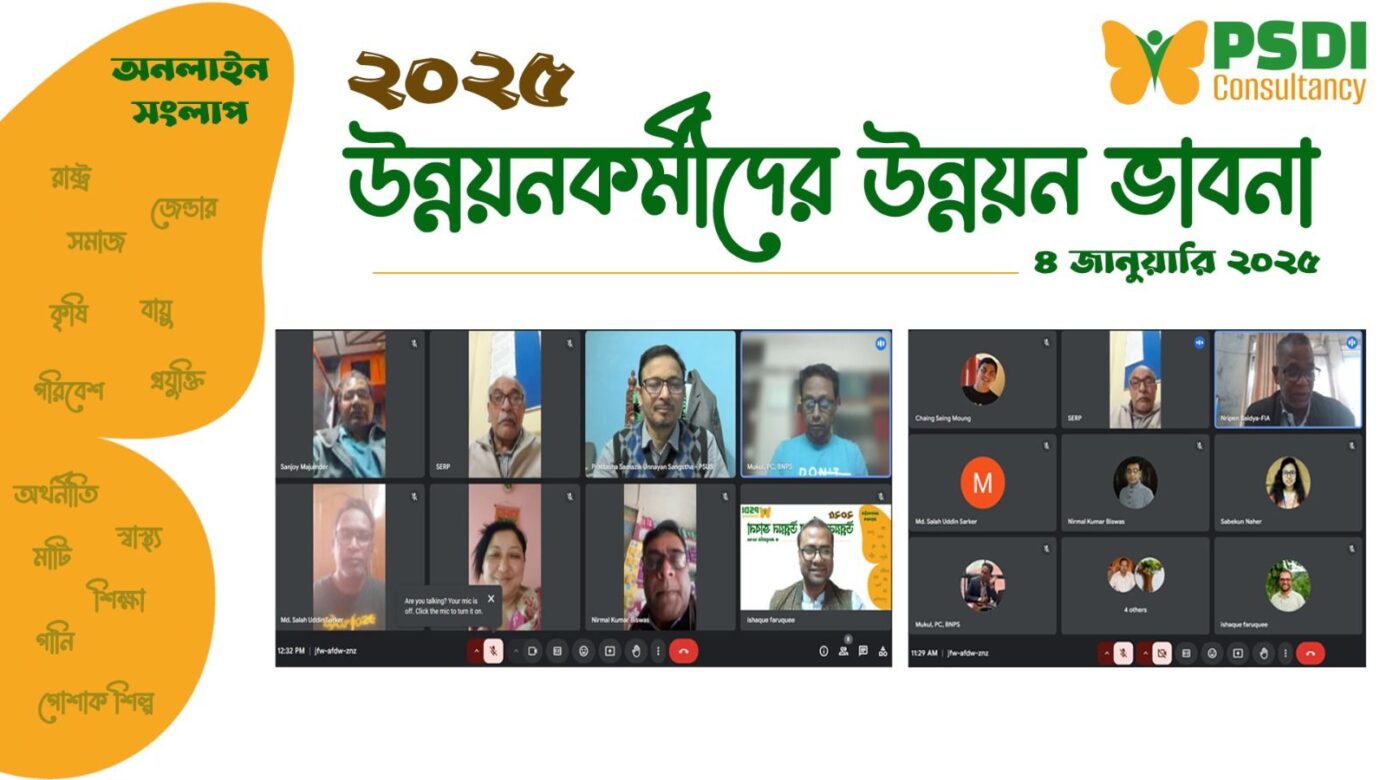
Development Workers’ Development Dialogue 2025
Local Organizations’ Engagement is Essential in Development Budget Planning
In the context of national development in 2024 and the ongoing changes, speakers emphasized that alongside identifying local challenges, the engagement and capacity enhancement of local development organizations is crucial in the National Development Budget Planning for 2025. They shared these views in a webinar titled “Development Workers’ Development Dialogue 2025.” The dialogue was organized by PSDI Consultancy on Saturday, January 4, with participation from development organizations from different districts of the country.
Participants included:
Chaing Seing Mong, Executive Director of GRAUS (Gram Unnayon Sangathon), Bandarban;
Sucharita Chakma, Executive Director of PROGRESSIVE, Rangamati;
Jafar Iqbal Chowdhury, Chief Executive of ASSED Habiganj, and Program Manager Nirmal Kumar Biswas;
Himangshu Chandra Topon, Founder Director of SERP (Service Emergency for Rural People), Thakurgaon;
Nripen Baidya, Executive Director of Faith in Action;
Md. Billal Hossain, Executive Director of Protyasha Social Development Organization (PSUS), Chuadanga;
Sabbekunnahar, Program Manager of NGO Unnayan, Khulna;
Md. Moniruzzaman Mukul, General Secretary of the Street Children Activists Network (SCAN), Bangladesh;
Development workers Basanti Saha, Sanjoy Majumder, and Md. Salahuddin Sarkar (Tuhin).
The session was moderated by Md. Ishaque Faruquee, Director of PSDI Consultancy.
During the dialogue, speakers stressed that to ensure the country’s development, foreign donor agencies should allocate funds to local development organizations, and for that, strengthening their institutional capacity is essential. They suggested nationwide joint project implementation through collective efforts.
They also highlighted the need for:
-
Education and adaptation to combat climate change
-
Making youth more employment-oriented to utilize the demographic dividend
-
Inclusive development planning involving persons with disabilities, Dalits, and all marginalized groups
-
Eco-village or eco-tourism initiatives and natural resource management in the hills
-
Ensuring farmers’ control and security in food production for the deprived indigenous peoples in the plains, establishing food sovereignty
-
Organizing dialogues to foster harmony among people of all religions
-
Effective planning and implementation to prevent child marriage and address gender issues
-
Prioritizing small or local NGOs in fund allocation
-
Giving importance to hill agriculture
-
Taking preventive measures against trafficking of women in the hill districts
-
Joint funding approaches between hills and plains to eliminate gender discrimination
-
Development planning focusing on agriculture and fisheries in the Haor region
-
Parenting initiatives and behavior change among boys towards girls
-
Considering the 95% of informal-sector child laborers alongside the 5% in the formal sector in national development strategies
-
Collecting and effectively utilizing Corporate Social Responsibility (CSR) funds from corporate organizations to support development initiatives


