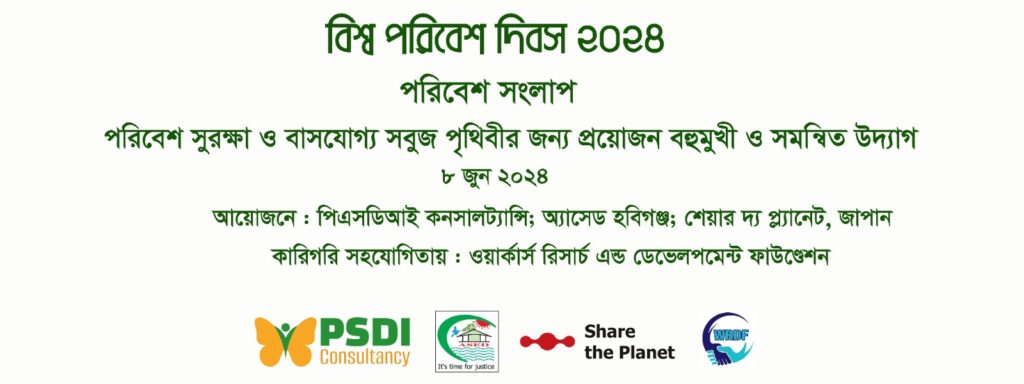

Online Environmental Dialogue
On 8 June 2024, an online environmental dialogue titled “Multifaceted and Coordinated Actions are Essential for Environmental Protection and a Green, Livable Planet” was jointly organized by PSDI Consultancy, ASOD Habiganj, and Share the Planet.
The dialogue was moderated by Md. Ishaque Faruquee, Chairperson of PSDI Consultancy.
The discussants included:
- Jafar Iqbal Chowdhury, Chief Executive of ASOD Habiganj
- Nripen Baidya, Executive Director of Faith in Action
- Nikhil Chandra Bhadra, Coordinator of the Sundarbans and Coastal Protection Movement
- Papia Dey, Executive Director of Upama Nari Kalyan Sangstha, Cox’s Bazar
- Sharif Chauhan, President of People’s Voice Chattogram
- Saing Saing O Nini, Faculty Coordinator of the School of Business Administration, Bandarban University
- Khairul Mamun Mintu, Trade union leader
- Tuhin Sarker, Development researcher and anthropologist
The speakers emphasized planned actions, coordinated initiatives, and increased budget allocation for environmental protection.
Nikhil Bhadra said that due to Cyclone Remal, the lives and livelihoods of coastal communities are now in extreme danger. The Sundarbans act as a protective shield against cyclones, yet there are hardly any initiatives to preserve its biodiversity—instead, destructive activities are rising. Like shelter projects for people, initiatives should be taken to protect animals. Coastal houses should be transformed into shelters under the concept of “One House One Farm.” Although the government has allocated a budget for environmental protection, no specific expenditure sectors have been determined. Local people must be involved in budget implementation.
Nripen Baidya said that international agencies like the World Bank prefer to provide loans rather than grants for disaster-related interventions, even though their contribution to climate change is the highest. Developing countries are more interested in investing in weapons than in environmental protection. However, we too are partly responsible for environmental destruction. Due to Cyclone Remal, many coastal people are still waterlogged. Government efforts have reduced casualties, but livelihoods have been severely affected. Disaster risk reduction must involve local communities.
Papia Dey noted that the forced displacement of the Rohingya population has long been an issue. The region holds special significance as sea and mountains converge here. Rohingya influx has caused forest destruction, disruption of elephant corridors, hill degradation, farmland loss, and severe damage to the ecosystem due to unplanned development.
Sharif Chauhan said that Chattogram—rich in rivers, hills, and the sea—is now at alarming risk. Hill cutting, river encroachment, and unplanned urbanization have ruined the city’s natural balance. Waste management has collapsed, rivers are polluted, hills are being cut for roads, and landslides are increasing. Due to the lack of genuine commitment toward environmental improvement among city planners, Chattogram is becoming uninhabitable. Implementing the 1961 Master Plan is essential for effective urban management.
Saing Saing O Nini said that around 80,000 hectares of land in the Chittagong Hill Tracts (CHT) have been lost. Nearly 80% of people have no land ownership and there is no clear policy framework. Driven by survival, forests are being destroyed, and unplanned agriculture is harming food production. Sometimes the private sector—especially tourism—damages nature in the name of development. An integrated and participatory plan is needed for CHT environmental protection. A well-planned tourism industry involving youth and community-based tourism would create employment and protect nature. The government must launch large-scale awareness campaigns.
Tuhin Sarker stated that northern Bangladesh suffers from geopolitical complexity. Rivers are drying up, severely affecting agriculture and livelihoods. The Teesta River—vital for northern agriculture—is drying out and the region is turning arid. Deep tube wells installed to maintain agriculture may cause long-term crises. Agricultural workers are being displaced and forced to shift careers. This issue must be viewed as a regional problem; implementation of cross-border river agreements is critical.
Jafar Iqbal Chowdhury said that Haor regions are among the most vulnerable to environmental disaster, yet they are the most neglected. One-fifth of the country’s total food grains come from Haor areas, making them a major source of national food security. Specific Haor zones remain submerged every year due to human-induced environmental pressure from neighboring countries. There are major shortcomings in government development plans: rivers and canals are silted up and upstream water flow causes floods, destroying nearly 25% of crops—impacting the national economy. Therefore, dredging canals and wetlands is urgently needed to protect the environment.